


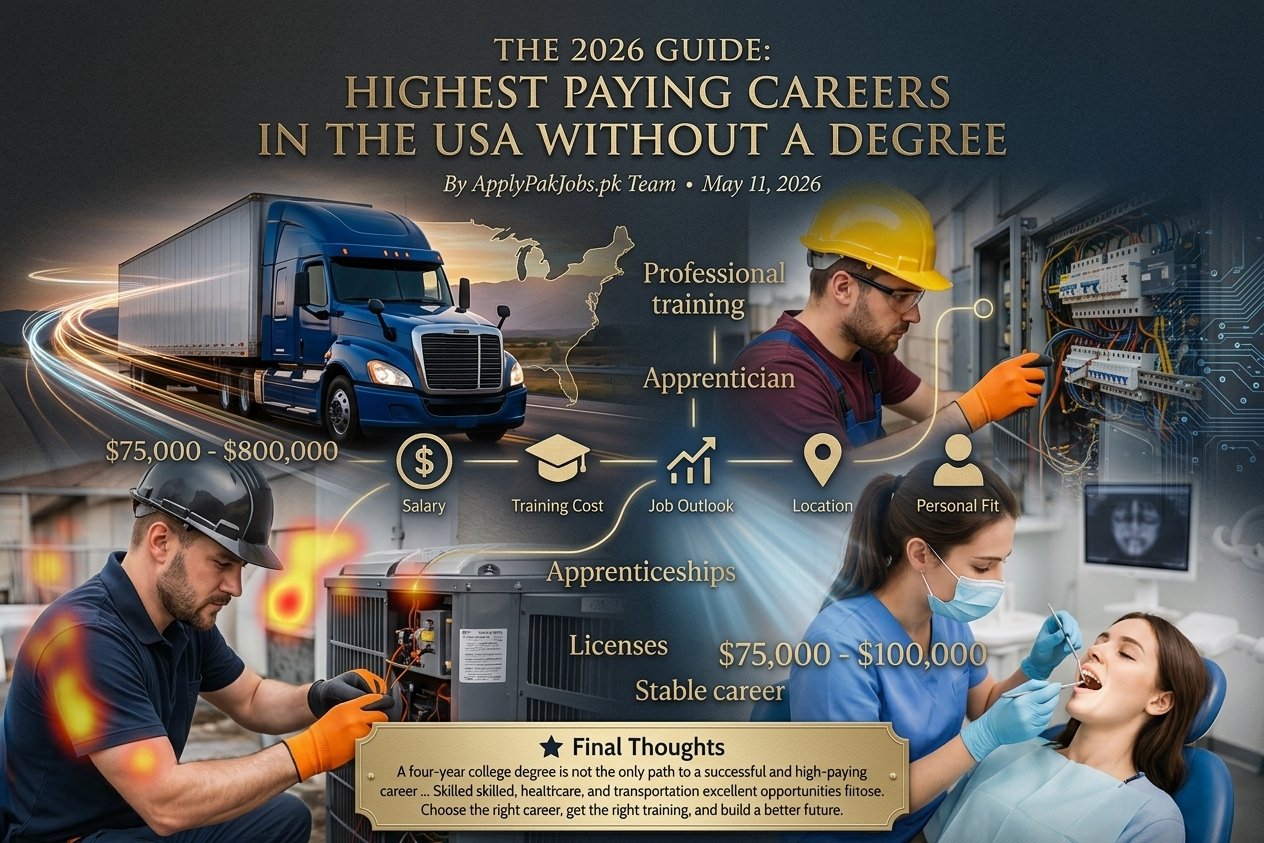
Highest Paying Jobs in the USA Without a Degree:
You do not always need a four-year college degree to build a well-paying career in the United States. Many employers hire workers based on technical skills, professional training, certifications, apprenticeships, licenses, and hands-on experience.
Some careers can offer strong earning potential without requiring a traditional bachelor’s degree. Examples include skilled trades, transportation, healthcare support, technology, sales, and specialized technical occupations.
In this guide, you’ll learn about some of the Highest Paying Jobs career options that may be available without a bachelor’s degree, what each career requires, typical salary information, and how to get started.
Quick Overview
| Career | Typical Education/Training | Career Potential |
|---|---|---|
| Commercial Truck Driver | CDL training | High |
| HVAC Technician | Technical training/certification | High |
| Electrician | Apprenticeship/license | High |
| Plumber | Apprenticeship/license | High |
| Dental Hygienist | Associate degree/license | High |
| Medical Sonographer | Associate degree/certification | High |
| Aircraft Mechanic | Technical training/certification | High |
| Web Developer | Skills/portfolio or formal training | High |
| IT Support Specialist | Certifications/training | Medium–High |
| Wind Turbine Technician | Technical training | High |
Important: Salary varies considerably by occupation, state, experience, employer, overtime, licensing, and specialization. Use current U.S. Bureau of Labor Statistics data when comparing occupations.
1. Commercial Truck Driver:

Commercial truck driving is one of the better-known career paths that does not require a four-year college degree.
Most professional truck drivers need a Commercial Driver’s License (CDL) and must meet applicable federal and state requirements.
How to get started
- Check your state’s CDL requirements.
- Complete appropriate CDL training.
- Pass the required knowledge and skills tests.
- Apply for entry-level driving positions.
- Build experience and consider specialized driving.
Specialized routes, equipment, and experience can affect earning potential.
2. HVAC Technician:

Heating, ventilation, and air-conditioning technicians install, maintain, and repair climate-control systems.
HVAC can be an attractive career for people who prefer practical, hands-on work.(Highest Paying Jobs)
Typical path
High school/GED → Technical training or apprenticeship → Certification/licensing where required → Entry-level HVAC technician → Experienced technician
Depending on the work performed, technicians may need specific certifications and state or local licenses.
3. Electrician:

Electricians install, maintain, and repair electrical systems in homes, commercial buildings, and industrial environments.
A common route into the profession is an apprenticeship that combines classroom instruction with paid practical training.(Highest Paying Jobs)
Skills that help
- Electrical safety
- Troubleshooting
- Blueprint reading
- Mathematics
- Problem solving
- Hand and power tools
Licensing requirements vary by state and locality, so applicants should check official state or local requirements.
4. Plumber:
Plumbers install and repair water, drainage, and related piping systems.
Many plumbers enter the occupation through apprenticeships and progress toward additional licensing and specialization.
Experienced plumbers may increase their earning potential by developing expertise in commercial, industrial, or specialized plumbing work.(Highest Paying Jobs)
5. Dental Hygienist:

Dental hygienists provide preventive oral healthcare and work alongside dentists.
Unlike some skilled trades, becoming a dental hygienist generally requires specialized postsecondary education and professional licensing. Therefore, “without a degree” should not be interpreted as “without any college education.”
People interested in this career should check the licensing requirements of the state where they plan to work.
6. Diagnostic Medical Sonographer
Diagnostic medical sonographers operate ultrasound equipment to create images used by healthcare professionals.
This career generally requires specialized education and clinical training, but it does not typically follow the four-year bachelor’s-degree path required by many professional occupations.(Highest Paying Jobs)
Healthcare careers can be particularly attractive to people looking for occupations with specialized training and long-term demand.
7. Aircraft Mechanic
Aircraft mechanics and service technicians inspect, maintain, and repair aircraft.
This career requires technical knowledge, careful attention to safety procedures, and appropriate training or certification.
People interested in aviation maintenance should research Federal Aviation Administration requirements and approved training pathways.
8. Web Developer
Web development can be different from traditional occupations because employers may evaluate skills, portfolios, and practical experience in addition to formal education.
Useful skills include:
- HTML
- CSS
- JavaScript
- Responsive design
- Accessibility
- Version control
- Basic web security
A strong portfolio can demonstrate practical ability to prospective employers.
9. IT Support Specialist
IT support professionals help users troubleshoot computer, software, networking, and account-related problems.
A four-year degree may not be necessary for every entry-level IT support position.
Beginner certifications can help candidates demonstrate foundational knowledge.
A possible career progression is:(Highest Paying Jobs)
IT Support → Systems Administration → Cloud → Cybersecurity → Specialized IT Role
10. Wind Turbine Technician
Wind turbine technicians install, maintain, and repair wind turbines.
The occupation requires technical knowledge, physical fitness for certain working environments, safety awareness, and specialized training.
The U.S. Bureau of Labor Statistics lists wind turbine service technicians among the country’s fastest-growing occupations.
Do You Really Need a College Degree?
Not necessarily.
The right question is:
What education, training, certification, or license does the specific occupation require?
Some careers genuinely require a bachelor’s degree or higher. Others rely heavily on apprenticeships, vocational education, associate-level education, licenses, certifications, or employer training.(Highest Paying Jobs)
For example:
Skilled trade:
Training → Apprenticeship → License → Experienced worker
IT:
Self-study → Certification → Portfolio → Entry-level position → Experience
Healthcare:
Specialized education → Clinical training → License/certification → Employment
How to Choose the Right Career
Consider these five factors before choosing a career:
1. Salary
Don’t look only at the maximum possible salary. Compare median pay, entry-level compensation, overtime opportunities, and regional differences.
2. Training Cost
A career requiring a short certification may have a very different financial return from one requiring several years of education.
3. Job Outlook
Look at projected employment growth and the number of annual openings.
4. Location
The same occupation can have significantly different wages and employment opportunities across U.S. states.
5. Personal Fit
Consider whether you prefer:
- Office work
- Remote work
- Healthcare
- Technology
- Construction
- Mechanical work
- Outdoor work
- Customer service
States to Consider
Career opportunities vary throughout the United States.
For future research, compare occupations in states such as:
- Texas
- California
- Florida
- New York
- Washington
- Arizona
- Colorado
- Virginia
- North Carolina
- Massachusetts
Don’t assume that the highest salary automatically means the best opportunity. Housing costs, taxes, licensing requirements, commute times, and local demand can significantly affect the overall value of a job.(Highest Paying Jobs)
How to Start Without a Bachelor’s Degree
A practical career strategy is:
Step 1 — Choose an occupation
Pick a field based on your interests and employment prospects.
Step 2 — Check official requirements
Research requirements through government agencies, licensing boards, and recognized professional organizations.
Step 3 — Choose affordable training
Compare community colleges, vocational schools, apprenticeships, employer training, and recognized certification programs.
Step 4 — Build practical skills
Employers often value demonstrated ability.
Create projects, complete supervised training, or gain hands-on experience where appropriate.
Step 5 — Create a professional resume
Highlight:
- Technical skills
- Certifications
- Projects
- Training
- Experience
- Relevant achievements
Step 6 — Apply strategically
Target jobs that match your actual qualifications instead of applying to every position.
Frequently Asked Questions:(Highest Paying Jobs)
What is the highest-paying job without a bachelor’s degree?
There is no single answer because pay varies by occupation, experience, location, specialization, overtime, and employer. Some technical, healthcare, transportation, and skilled-trade careers can provide strong earning potential without requiring a bachelor’s degree.
Can I make $70,000 without a college degree?
Yes, some occupations can reach or exceed that level, but income depends heavily on the occupation, experience, location, hours, and qualifications.
Can I make $100,000 without a degree?
Some workers can reach six-figure earnings without a bachelor’s degree, particularly in specialized technical occupations, skilled trades, sales, transportation, and certain business roles. However, six-figure income should never be presented as guaranteed.(Highest Paying Jobs)
What certification can help me get a high-paying job?
The best certification depends on your career goal. IT, cybersecurity, healthcare, skilled trades, transportation, and technical careers each have different certification pathways.
Are trade jobs good careers?
They can be. Skilled trades can provide practical career paths, opportunities for specialization, and in some cases strong earning potential.(Highest Paying Jobs)
Are online certifications enough to get a job?
Not always. A certification can demonstrate knowledge, but employers may also require practical skills, experience, licensing, education, or other qualifications.
Final Thoughts
A four-year college degree is not the only route to a successful career in the United States.
Skilled trades, healthcare, technology, transportation, and specialized technical occupations can offer alternative career pathways. The best choice depends on your skills, training budget, location, interests, and long-term goals.
Before choosing a career, compare official salary data, job outlook, training requirements, licensing rules, and local employment opportunities rather than relying on a single salary claim.(Highest Paying Jobs)