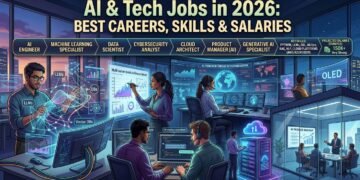


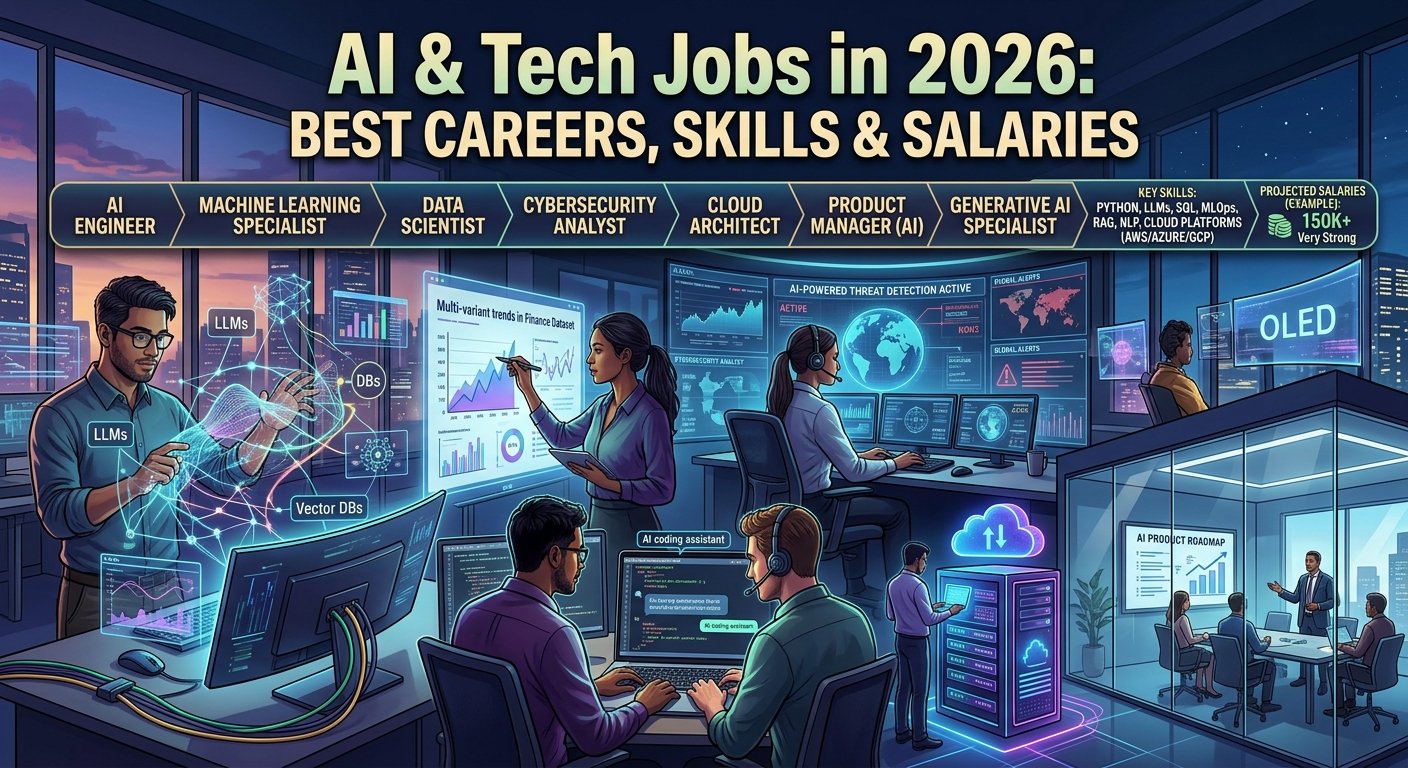
AI & Tech Jobs in 2026: Where the Best Career Opportunities Are.
Artificial intelligence is no longer a technology limited to research laboratories and large technology companies. In 2026, AI is increasingly being integrated into software development, cybersecurity, finance, healthcare, marketing, manufacturing, cloud computing and business operations.
That transformation is creating new career opportunities while changing the skills employers expect from existing technology professionals.
According to the U.S. Bureau of Labor Statistics, several technology-related occupations are projected to grow significantly from 2024 through 2034. Data scientist employment is projected to grow 33.5%, information security analyst employment 28.5%, and software developer employment 15.8% during that period.
Globally, the World Economic Forum also identifies AI and machine learning specialists, big data specialists, fintech engineers and software/application developers among the fastest-growing technology-related roles through 2030.
For job seekers, the message is clear:
Learning technology alone is no longer enough. The strongest candidates combine technical expertise with AI literacy, analytical thinking, communication and real-world problem-solving.
Table of Contents
- What Are AI & Tech Jobs?
- Why AI & Technology Careers Are Growing
- Best AI & Tech Jobs in 2026
- AI Engineer
- Machine Learning Engineer
- Data Scientist
- Cybersecurity Analyst
- Software Developer
- Cloud Engineer
- AI Product Manager
- Data Engineer
- AI Automation Specialist
- Generative AI Specialist
- Technology Skills Employers Want
- How to Start an AI Career
- Best AI Jobs for Beginners
- Are AI Jobs Still Worth It?
- How AI Is Changing Software Jobs
- Remote AI & Tech Jobs
- How to Build an AI-Tech Resume
- Future of AI & Tech Careers
- Frequently Asked Questions
What Are AI & Tech Jobs?
AI and tech jobs include careers involving software, artificial intelligence, machine learning, data, cybersecurity, cloud infrastructure, automation and digital products.
Some positions require advanced programming and mathematics, while others combine technology with business, communication, design or management.
Examples include:
- AI Engineer
- Machine Learning Engineer
- Data Scientist
- Data Engineer
- Software Developer
- Cybersecurity Analyst
- Cloud Engineer
- AI Product Manager
- Generative AI Specialist
- AI Automation Specialist
- DevOps Engineer
- Computer Research Scientist
- UX/Product Designer
- Technology Consultant
The important point is that AI careers are becoming broader than traditional programming jobs.
A professional working in marketing, finance, healthcare or operations can increasingly benefit from AI skills without becoming a full-time machine-learning engineer.
Why Are AI & Tech Jobs Growing?

Several forces are driving demand.
1. Businesses are adopting AI
Companies are using AI for customer support, document processing, software development, forecasting, research, marketing and internal automation.
The World Economic Forum reports that AI and information-processing technologies are among the major technologies expected to transform businesses through 2030.
2. Cybersecurity threats are increasing
As organizations move more operations online, protecting networks, applications and sensitive information becomes increasingly important.
BLS projects information security analyst employment to grow 28.5% between 2024 and 2034.
3. Companies need more data professionals
Modern companies generate enormous amounts of data.
Businesses need professionals who can collect, clean, analyze and interpret that information.
BLS projects data scientist employment to increase 33.5% from 2024 to 2034, representing approximately 82,500 additional jobs.
4. Software remains essential
AI can automate parts of programming, but companies still need people who understand architecture, security, systems integration, product requirements and software quality.
BLS projects 267,700 additional software developer jobs from 2024 through 2034, with employment growth of 15.8%.
10 Best AI & Tech Jobs in 2026
| Career | Main Skills | Growth Outlook |
|---|---|---|
| AI Engineer | Python, APIs, ML, LLMs | Very Strong |
| Machine Learning Engineer | ML, Python, statistics | Very Strong |
| Data Scientist | Python, statistics, SQL | Very Strong |
| Cybersecurity Analyst | Security, networking, SIEM | Very Strong |
| Software Developer | Programming, APIs, cloud | Strong |
| Cloud Engineer | AWS/Azure/GCP, Linux | Strong |
| Data Engineer | SQL, Python, pipelines | Strong |
| AI Product Manager | Product + AI knowledge | Strong |
| AI Automation Specialist | AI tools, APIs, workflows | Emerging |
| Generative AI Specialist | LLMs, RAG, evaluation | Emerging/Strong |
1. AI Engineer
AI engineering is one of the most attractive technology career paths for people who want to work directly with artificial intelligence.
AI engineers build and integrate AI-powered applications.
Their work can include:
- Large language models
- AI APIs
- Retrieval-augmented generation
- AI agents
- Machine-learning systems
- Recommendation systems
- Natural-language applications
- AI automation
- Model evaluation
Skills to Learn
A strong AI engineer should understand:
- Python
- APIs
- Git
- SQL
- Machine learning fundamentals
- Cloud platforms
- LLM concepts
- Vector databases
- RAG architectures
- Model evaluation
- AI security
You don’t necessarily need to build a foundation model from scratch.
For many commercial applications, the more valuable skill is knowing how to integrate AI into a real business product.
2. Machine Learning Engineer
Machine learning engineers focus on developing, deploying and maintaining machine-learning systems.
Typical responsibilities can include:
- Training models
- Preparing datasets
- Evaluating models
- Deploying ML systems
- Monitoring model performance
- Improving prediction accuracy
- Building machine-learning pipelines
Important Skills
Learn:
Python + SQL + statistics + machine learning + cloud + MLOps
A portfolio can make a major difference.
For example, instead of simply writing “Machine Learning” on a resume, create a project that predicts customer churn, detects fraud or forecasts demand.
That gives employers something concrete to evaluate.
3. Data Scientist
Data science remains one of the strongest technology career paths.
BLS projects 33.5% employment growth for data scientists between 2024 and 2034, making it one of the fastest-growing occupations listed in its AI/IT analysis.
Data scientists use data to answer business and technical questions.
Common responsibilities include:
- Data analysis
- Statistical modeling
- Machine learning
- Visualization
- Forecasting
- Experimentation
- Business intelligence
Skills to Learn
Start with:
- Python
- SQL
- Statistics
- Pandas
- Data visualization
- Machine learning
- Excel
- Power BI or Tableau
Then specialize in an industry such as finance, healthcare, retail or technology.
4. Cybersecurity Analyst
Cybersecurity is another highly valuable technology career.
Organizations need professionals who can detect attacks, investigate suspicious activity and protect systems.
BLS projects information security analyst employment to grow 28.5% from 2024 to 2034.
Useful Skills
Learn:
- Networking
- Linux
- Security fundamentals
- SIEM platforms
- Identity and access management
- Threat detection
- Incident response
- Cloud security
- Security frameworks
AI is also changing cybersecurity.
Security teams increasingly use automation and AI-assisted analysis to process large volumes of alerts.
That means future cybersecurity professionals may benefit from understanding both security and AI.
5. Software Developer
Software development remains one of the largest technology career opportunities.
The key difference in 2026 is that developers increasingly work alongside AI coding tools.
Instead of treating AI as a replacement for programming knowledge, developers can use it to accelerate:
- Code generation
- Testing
- Debugging
- Documentation
- Refactoring
- Prototyping
- Code review
But developers still need to understand the code they produce.
Recommended Skills
Choose one programming path:
Web development
HTML → CSS → JavaScript → React → Node.js
or
Backend development
Python/Java/Go → APIs → databases → cloud
or
Mobile development
Kotlin/Swift/Flutter/React Native
Then add AI integration skills.
6. Cloud Engineer
AI applications require infrastructure.
Cloud engineers help companies build and operate that infrastructure.
Popular areas include:
- Cloud architecture
- Kubernetes
- Containers
- Infrastructure as code
- Networking
- Cloud security
- Serverless computing
- Monitoring
Major cloud platforms include AWS, Microsoft Azure and Google Cloud.
A particularly valuable combination is:
Cloud + AI + cybersecurity
Professionals who understand all three areas can work across a wide range of projects.
7. AI Product Manager
Not every AI career requires advanced programming.
AI product managers work between business teams, engineers, designers and customers.
They determine:
- What AI product should be built?
- What problem does it solve?
- Which AI model should be used?
- What data is required?
- How should performance be measured?
- What risks need to be controlled?
This career is ideal for people who combine:
Business knowledge + technology understanding + communication + product strategy
8. Data Engineer
Before data scientists and AI systems can do useful work, organizations need reliable data.
Data engineers build systems that collect, process and organize information.
Common technologies include:
- SQL
- Python
- Spark
- Data warehouses
- ETL/ELT pipelines
- APIs
- Cloud platforms
- Databases
Data engineering can therefore be an excellent foundation for moving into AI and machine learning.
9. AI Automation Specialist
AI automation is an emerging career path for professionals who help businesses automate repetitive workflows.
For example, an automation system might:
- Receive a customer inquiry.
- Classify the request using AI.
- Extract important information.
- Search a knowledge base.
- Generate a response.
- Update a CRM.
- Notify an employee when human intervention is required.
The specialist doesn’t necessarily need to develop an AI model.
Instead, they need to understand business processes, APIs, AI tools and workflow automation.
10. Generative AI Specialist
Generative AI has created demand for professionals who understand how to work with AI models effectively.
Skills can include:
- Prompt engineering
- LLM APIs
- RAG
- AI agents
- Evaluation
- Structured outputs
- AI workflow design
- AI safety
- Model selection
However, simply knowing how to write prompts may not be enough for a long-term career.
The stronger strategy is to combine generative AI with another skill.
For example:
Marketing + AI
Programming + AI
Cybersecurity + AI
Finance + AI
Data analysis + AI
This creates a more defensible professional profile.
Most Valuable AI & Tech Skills for 2026:

The World Economic Forum identifies AI and big data among the fastest-growing skills through 2030, followed by networks and cybersecurity and technological literacy. It also emphasizes analytical thinking, creative thinking, resilience, flexibility and collaboration.
A strong 2026 skill stack therefore looks like this:
Technical Skills
- Artificial intelligence
- Machine learning
- Python
- SQL
- Cloud computing
- Cybersecurity
- Data analytics
- APIs
- Automation
- Git
- Linux
Human Skills
- Analytical thinking
- Communication
- Problem solving
- Creativity
- Leadership
- Collaboration
- Adaptability
- Continuous learning
The combination is important.
AI + human judgment is more valuable than AI knowledge alone.
How to Start an AI Career Without Years of Experience
You don’t necessarily need to wait until you have a perfect degree or years of professional experience.
A practical pathway is:
Step 1: Choose One Career
Don’t try to learn every technology simultaneously.
Pick one:
- AI engineering
- Data science
- Cybersecurity
- Software development
- Cloud
- Data engineering
- AI automation
Step 2: Learn the Fundamentals
Spend several weeks building foundational knowledge.
For example:
AI path: Python → statistics → ML → APIs → LLMs
Cybersecurity path: Networking → Linux → security fundamentals → SIEM
Software path: Programming → Git → databases → APIs → cloud
Step 3: Build Projects
Projects are extremely important.
Instead of saying:
“I know Python.”
Show:
“I built a Python-based customer analytics application.”
Step 4: Publish Your Portfolio
Create a professional portfolio containing:
- GitHub projects
- Project explanations
- Screenshots
- Technical documentation
- Live demos when possible
- Your role in each project
Step 5: Apply Strategically
Don’t send the same generic resume to 500 jobs.
Customize your application for the role.
Best AI Jobs for Beginners
People entering technology may find some paths more accessible than others.
Beginner-Friendly Options
AI Automation Specialist
Good for people interested in business workflows and no-code/low-code tools.
Junior Data Analyst
A practical entry point for people interested in data.
Junior Software Developer
Suitable for people willing to learn programming.
IT Support + AI
Can provide a foundation for cloud, cybersecurity and systems administration.
QA/Software Testing
AI-assisted testing is creating new opportunities for people who understand software quality.
The important thing is to choose a path where you can realistically build demonstrable skills.
Are AI Jobs Still Worth It in 2026?
Yes—but the definition of an “AI job” is changing.
AI is not simply creating a separate category of workers who build models.
It is also changing existing occupations.
A software developer may now use AI coding assistants.
A marketer may use AI for research and content workflows.
A financial analyst may use AI for document analysis.
A cybersecurity professional may use AI for threat investigation.
A product manager may use AI to analyze customer feedback.
This means AI literacy is increasingly becoming a career multiplier.
At the same time, job seekers should avoid assuming that every AI-related position is automatically secure. Current labor-market evidence shows that AI exposure can change hiring patterns and reduce demand for some tasks while increasing demand for other skills.
How AI Is Changing Software Development:

Software developers are not disappearing.
Instead, the development workflow is changing.
AI tools can help developers:
- Generate code
- Explain unfamiliar code
- Write tests
- Find bugs
- Create documentation
- Convert code between languages
- Prototype applications
But AI-generated code can contain:
- Security vulnerabilities
- Incorrect assumptions
- Performance problems
- Bugs
- Outdated approaches
Therefore, developers who understand software architecture and can evaluate AI-generated output remain important.
The winning skill isn’t simply:
“I can use an AI coding tool.”
It is:
“I can use AI to build reliable software faster.”
Remote AI & Tech Jobs
Remote work has made technology careers accessible across geographic boundaries.
Potential remote positions include:
- Software Developer
- Data Analyst
- Data Scientist
- AI Engineer
- Cybersecurity Analyst
- Cloud Engineer
- DevOps Engineer
- AI Automation Specialist
- Technical Writer
- AI Product Manager
However, remote jobs are often highly competitive.
To stand out, focus on measurable results.
Instead of writing:
Experienced with AI.
Use evidence such as:
Built an AI document-processing workflow that automatically classified and summarized customer requests.
Specific achievements are more persuasive than buzzwords.
How to Build an AI-Tech Resume in 2026
A modern technology resume should quickly communicate:
What you know + what you built + what impact you created.
Recommended Resume Structure
1. Professional Summary
Two or three sentences describing your specialization.
2. Technical Skills
List relevant technologies rather than every tool you’ve ever touched.
3. Projects
Include your strongest projects.
4. Work Experience
Focus on measurable outcomes.
5. Education
Include relevant degrees, certifications and training.
6. Portfolio
Add GitHub or a professional portfolio where appropriate.
Avoid stuffing your resume with AI buzzwords you cannot explain.
Employers can quickly discover when candidates list technologies without practical knowledge.
AI & Tech Career Roadmap
Here’s a simple roadmap for beginners:
Months 1–2: Fundamentals
Learn:
- Computer fundamentals
- Programming
- Git
- SQL
- Basic AI concepts
Months 3–4: Specialization
Choose one:
- AI
- Data
- Cybersecurity
- Software
- Cloud
Months 5–6: Portfolio
Build 3–5 serious projects.
Months 7–9: Professional Preparation
Improve:
- Resume
- LinkedIn profile
- GitHub
- Interview skills
- Technical communication
Months 10–12: Job Search
Apply consistently to:
- Full-time jobs
- Internships
- Junior positions
- Contract roles
- Freelance projects
The goal isn’t to collect dozens of certificates.
The goal is to become capable of solving real problems.
Future of AI & Tech Jobs Through 2030:

The long-term outlook remains strong for several technology categories.
The World Economic Forum estimates that technological and other structural changes could create 170 million jobs globally by 2030 while displacing 92 million, producing a net increase of 78 million jobs. It also estimates that around 39% of workers’ existing skill sets could be transformed or become outdated between 2025 and 2030.
This creates an important lesson:
The safest career strategy isn’t choosing one technology and never changing.
Instead:
Learn how to learn.
Technology changes rapidly.
Programming languages change.
AI models improve.
Cloud platforms evolve.
Automation tools appear.
Job titles change.
But the ability to understand problems, learn new systems and create measurable business value remains valuable.
Final Thoughts
AI and technology careers are entering an important phase.
The opportunity is significant, but competition is also increasing.
The people most likely to succeed won’t necessarily be those who know the most AI terminology.
They will be the people who can combine:
Technical skills + AI literacy + domain knowledge + communication + problem-solving.
If you’re starting today, don’t attempt to master everything.
Choose one career path.
Learn the fundamentals.
Build real projects.
Use AI as a productivity tool.
Create a strong portfolio.
Then apply consistently.
The future of work isn’t simply AI versus humans.
For many professionals, the more useful model is:
Humans who know how to work effectively with AI versus those who don’t.
Frequently Asked Questions
What are the best AI and tech jobs in 2026?
Some of the strongest technology career paths include AI engineering, machine learning, data science, cybersecurity, software development, cloud engineering, data engineering and AI product management.
What is the fastest-growing AI-related job?
BLS projects data scientist employment to grow 33.5% between 2024 and 2034, while information security analysts are projected to grow 28.5%.
Do I need a computer science degree for an AI job?
Not necessarily. Some advanced roles strongly benefit from formal education, but practical skills, projects, portfolios and relevant experience can also be important—especially for applied technology roles.
Is AI replacing software developers?
AI is automating parts of software development, but software developer employment is still projected to grow 15.8% from 2024 to 2034 in U.S. BLS projections.
What AI skill should beginners learn first?
Python, basic data concepts, APIs and practical generative-AI concepts are useful starting points. However, the best starting skill depends on your target career.
Are remote AI jobs available?
Yes. AI, software, data, cloud and cybersecurity work can often be performed remotely, although availability and eligibility vary by employer and location.
Which technology skills will be valuable through 2030?
The World Economic Forum identifies AI and big data, networks and cybersecurity, and technology literacy among the fastest-growing skill categories, alongside human capabilities such as analytical and creative thinking.
Is prompt engineering enough to get an AI job?
Prompting can be useful, but relying exclusively on prompt-writing skills is risky. Combining AI knowledge with programming, data, business, marketing, cybersecurity or another specialized skill creates a stronger career profile.